It’s spring, which is sufficient excuse to make some macarons. Yes, I can give you a reason from every season for making these delights. But spring, with its spectrum of a thousand shades of green and other noble colors, is a spectacular time for macaron treats.
There have been several posts on this blogs about macarons, both how to make them and surveys of the best in macaron books. From all of that experience, I’ve gleaned some insights for baking macarons: from starting with eggs white, to baking the shells, to making the filling, and on to storage.
Some of you may have seen books with 10 or 20 or more steps for successful macrons. I truly agree that “complexity” is real, based on my own experiences [both good and sad]. A macron looks and tastes perfect only if many steps have been followed. And followed in the right order at the right pace. Making macarons is not something you can say, “I’m doing a batch now!” It takes a few days of effort, particularly for those egg whites.
So, today, let’s have some getting started tips for making macarons. This post is not about a recipe. It is about general principles that really need to be followed for any macaron recipe. You want macaron perfection? Please read on!
There Are Days to Macaron and Days Not to Macaron
Beating egg whites to achieve a meringue is best done in a dry environment. If you live in Arizona, you are in luck almost every day. If you live in New Orleans, you have a challenge. Humidity is your enemy.
Freshness Is not Your Friend Either
Fresh egg whites are lovely. And wet. Reducing the amount of water in the egg whites will make the process of beating into a meringue far, far easier. There are a couple of techniques used here. One, put the egg whites in the refrigerator for up to a week, covered with plastic wrap with some holes punched in the top. Two, microwave the egg whites for about 10 seconds to “age” and to dry them.
Before Beating Your Egg Whites
Let them come to room temperature. Going from liquid whites to that rich ivory elegance of meringue is a major chemical process. Temperature is your friend to make that meringue appear gracefully.
Clean the Bowl Before Beating
Any oil in the bowl can making beating the eggs white harder. Or, as I once discovered, impossible. If you are cracking eggs, do it one egg at a time into a separate bowl to avoid contamination from yolk pieces that come along for the ride. If you get some yolk in that one-egg-at-a-time bowl, then toss that bowl and move on. No choice here.
How Do You Known When to Stop Beating the Egg Whites
Turn off your mixer. Pull the mixing bowl. Carefully turn it over. A proper meringue will just sit quietly in the bowl, no slipping, sliding, or plopping. You DON’T want to overbeat the meringue, for then your macrons will demonstrate dryness and cracking. You’ll need to experiment and to recognize that every baking session is unique: the temperature, the humidity, and the quality of the eggs all play key factors.
Coloring the Batter
Standard liquid food coloring has chemicals that can disturb beaten egg whites. So, to color the meringue, use either gel, powder, or paste. Use a toothpick to add just little touches of color. You’ll be amazed at how much color these professional products can produce. If you use too much, say blue, you’ll have Van Gogh blue batter. You’ll scream, your hands will reach to your ears, you’ll recall that art history class, and then you’ll scream more.
Remember: you can always darken a little more, but you can’t undarken.
And Take Care with Chocolate
Overbeating when cocoa is in the batter can release oils which also can affect the meringue. It is better to “undermix” and leave some streaks than to risk this oil problem. If the resulting macarons are not a solid color but have “streaks” then you can boast about your “arty macaron” techniques. Remember what Julia Child said as she picked up the chicken off the floor: never apologize.
Good luck! More to come soon about baking the shells and then storing your macarons.
Sources: Macarons by Pierre Herme and The Little Book of Macaroon Tips by Meg Avent
If you shop for macaroon [aka macaron] cookbooks, you’ll find a bevy in your bookstore or online. The pictures of intensely colored macaroons with intriguing flavor combinations can be overwhelming.
Suzen and I own a dozen of these books and we can help you sort out which books to consider and why. The table at the end of this blog compares seven of the books we’ve found to be most useful. And successful! We’ve been to Paris and we’ve tasted every color of Laduree’s treats, so we are official macaroon experts.
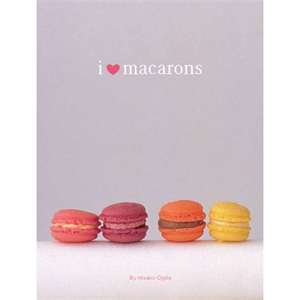
To get started, you need one book: I Love Macarons by Hisako Ogita [it’s officially I [Heart] Macarons]. Mrs Ogita is a Japanese baking maven who writes about French pastry techniques. Her book is the best because of the research and quality that it reflects on each page. She has refined the techniques for the home cook, and has majestically documented and photographed the steps to making a perfect macaroon.
There are two styles of macaroons:
French made with egg whites beaten into a meringue
Italian made with a hot sugar syrup added into an egg white meringue
Ogita’s book is one of two books that describe both techniques. She breaks the process down into microsteps, far more than any other author. And she provides pictures for every step. Suzen followed her exactly and had nothing short of Parisian quality. She was happy, and I was nourished.
For a second book, our favorite is Macarons by Berengere Abraham. It too breaks the process into many steps with photos of each one.
The other five books listed in this table are all excellent ones. For the experienced macaroon maker, they provide exciting flavor combinations. But, if you are just beginning and need expert advice on technique, then the books by Ogita and Abraham are essential.
Stores displaying macaroons often have a dozen different kinds, beginning, of course, with chocolate, vanilla, coffee, … In the last column of the table I’ve included for each book three of their “more exotic” flavor combinations. There are really an unlimited number of ways to flavor the cookie, then the filling, and finally apply some outside flavor or texture to the assembled macaroon [rolling in pistachios, for example].
Each of these seven books is rich in flavor ideas and combinations. Macaroon popularity is certainly due to the extravagance of these ideas. You kitchen is the place where you flavor imagination can literally go wild.
Title
Author
# of Steps
Technique
Technique Pictures
Recipes
I Love Macarons
Hisako Ogita
22 [French]
23[Italian]
French & Italian
Every Step
Sesame
Green Tea
Pistachio and Raspberry
Macarons
Berengere Abraham
12
French
Every Step
Rhubarb and Red Currant
Mango and Mascarpone
Pineapple and Szechuan Pepper
Macaroon
Alison Thompson
8
French
No
Vanilla and Rose
Cinnamon
Pecan Caramel
Macarons
Annie Rigg
12
French
Some
Raspberry and Passion Fruit
Coffee, Caramel and Chocolate
Caramel and Nutmet